Field Ops Copilot
AI-Augmented Project Management Platform for Construction
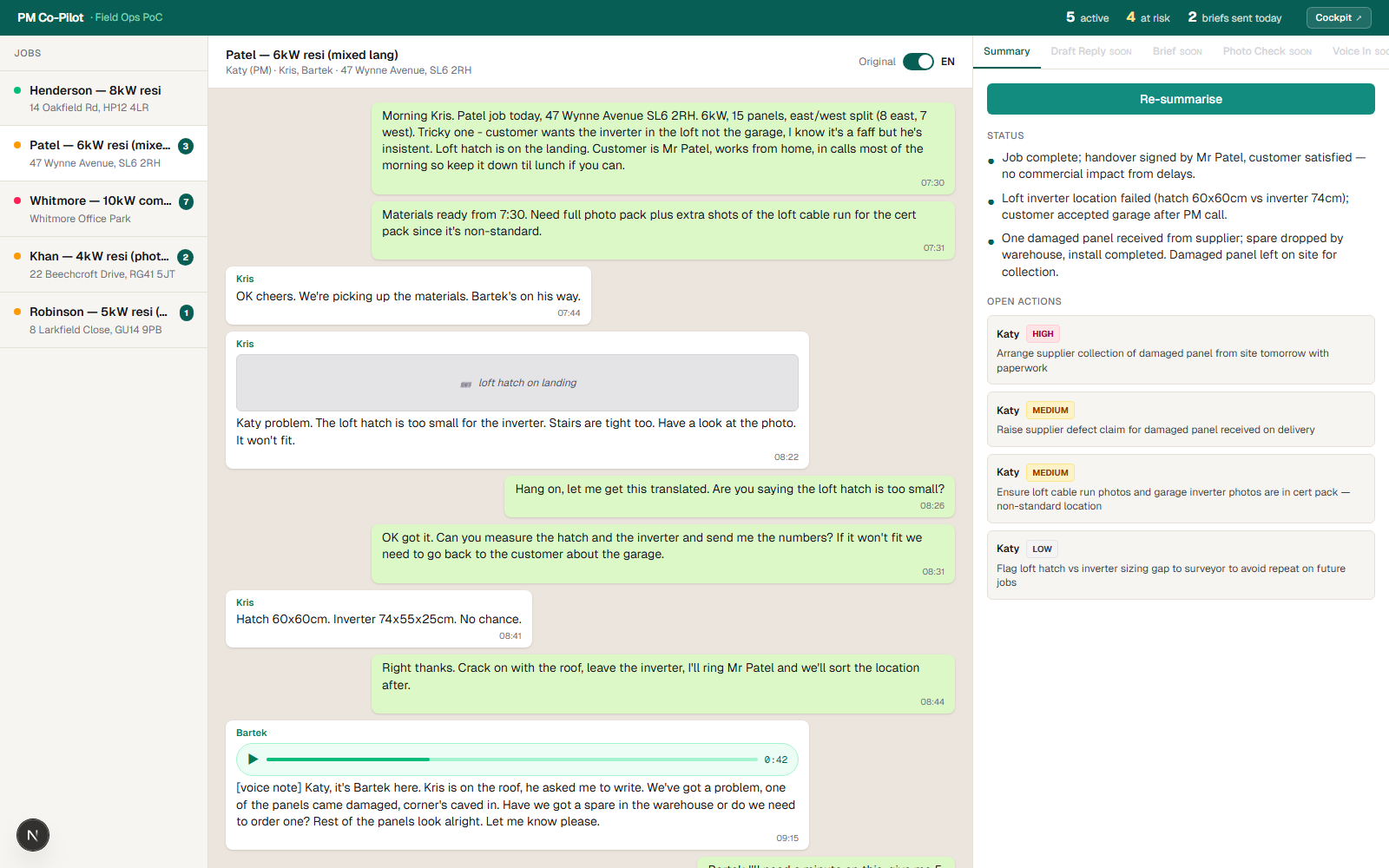
I observed that incumbent installation project-management tools all fail at the same point: installer crews refuse to migrate off WhatsApp. Field Ops Copilot dodges that fight entirely installers carry on as before, while the AI reads the resulting mess and gives the project manager a forward-looking decision queue.
Architecture
Sits on top of WhatsApp; no app for installers to adopt
Competitive Wedge
Incumbent architectures predate LLMs and cannot be retrofitted
Validation
The workflow already exists in the wild, done manually with basic AI tools (ChatGPT, Gemini, etc.)
Target User
Project managers and ops directors, not field crews
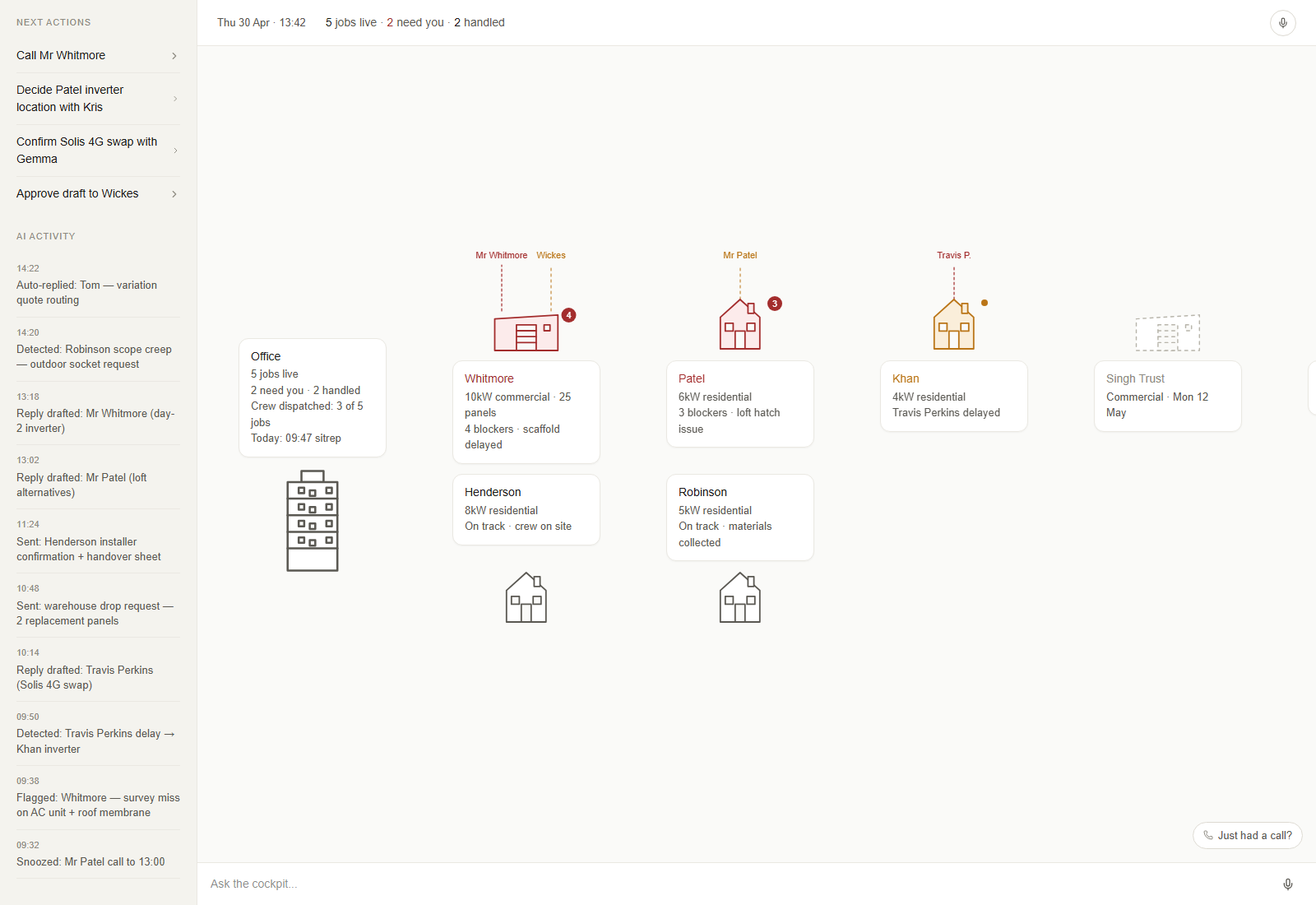
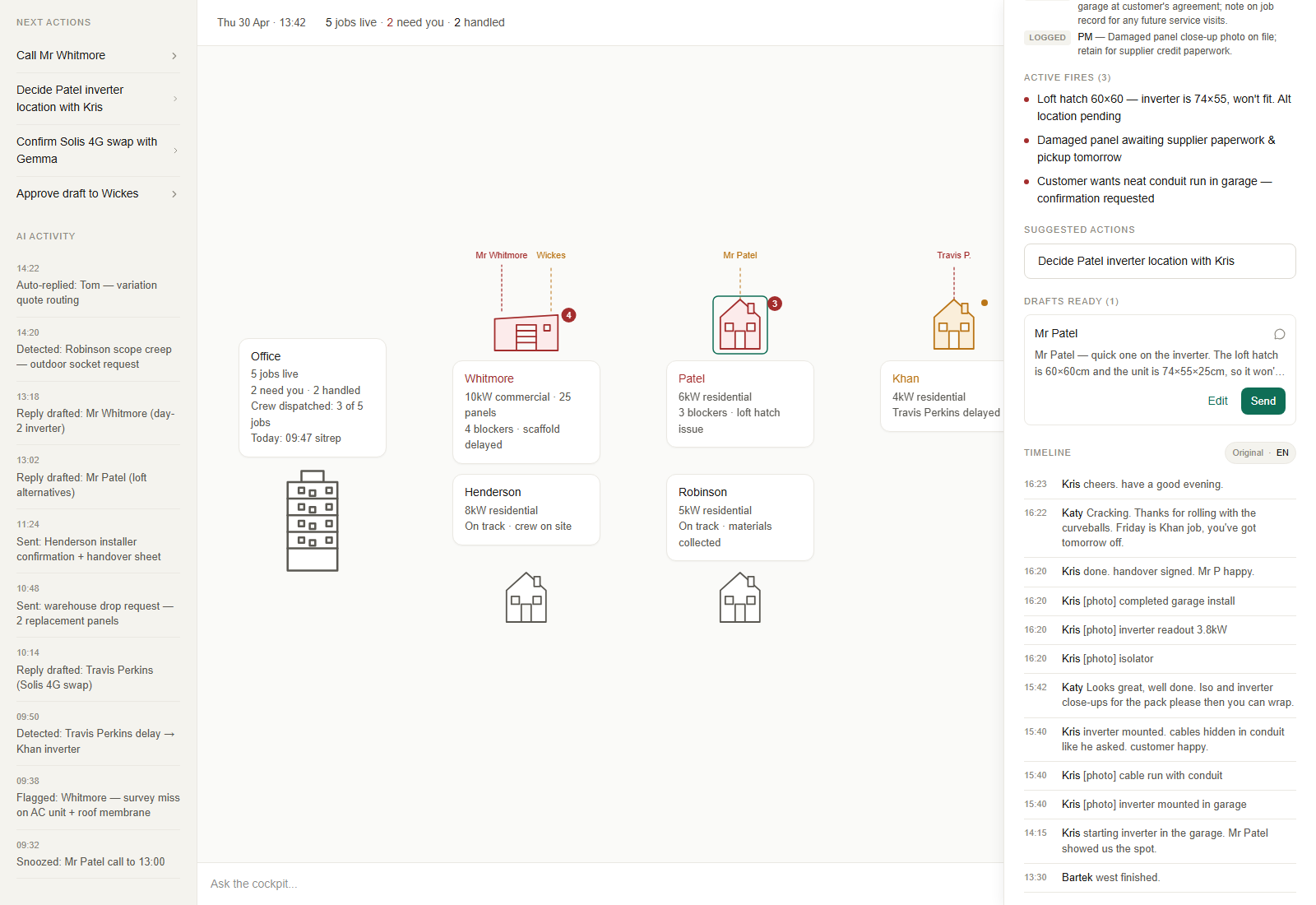
A WhatsApp-native AI cockpit for project managers running small-to-medium installation contractors — solar, kitchens, glazing, EV chargers, scaffolding.
The strategic wedge comes from observing why incumbent tools fail. Simpro, ServiceM8, BigChange, Tradify and similar platforms all try to migrate installer crews off WhatsApp and onto proprietary apps; installer adoption kills them. Field Ops Copilot dodges that fight entirely. Installers continue texting in WhatsApp. The AI reads the resulting mess — voice notes, photos, mixed-language threads, casual variation requests — and gives the project manager a ranked decision queue and a Gantt-aesthetic day view that auto-slots soft work between hard time blocks. The signal layer is the moat, not the language model.
Validation came from direct observation. Project managers at established installation businesses already use ChatGPT manually to decode multilingual voice notes and draft replies on behalf of their crews. The workflow already exists in the wild. Field Ops Copilot makes it native, ranked, and structured.
How it came about
Before this I worked as Head of Marketing at Spirit Energy, an installation contractor. Field Ops Copilot is direct fallout from what I saw operating there.
The most telling thing I watched was the cost of a junior question. An installer on site would wait ten to twenty minutes for a PM to come back on something the PM considered trivial — but those were minutes of billable crew standing around. Meanwhile that same PM might already be ninety minutes into a call with a customer who had either misunderstood the scope or expanded it. The bottleneck is rarely the work. It's the triage.
Why incumbent tools kept losing
Simpro, ServiceM8, BigChange and the rest are built for a different operator — a PM at a tech company, not a construction one. The pricing and workflows assume a user who treats software adoption as a normal part of the job and isn't already at full operational capacity. Construction PMs are not that buyer; asking them to restructure their operation onto a new platform is a "this is impossible right now" decision. And installers themselves won't migrate off WhatsApp — it's already on their phone. Any product whose plan involves moving them is fighting gravity.
What the product is really for
The PM's real cognitive load is triage and context-switching, not project management in the abstract. A useful tool ranks what to do next, holds the context they're switching between, and surfaces the signals that should change their priorities. The "signal layer is the moat" idea follows: a product that sits on top of WhatsApp is something construction operators — slow technology adopters by temperament — can deconstruct and understand. One that demands they restructure how their business communicates is not.